Ankit Anand
Technology leader, researcher, and Managing Consultant focused on data quality, master data management, and reliable enterprise AI.
Author profile →A practical guide to production machine learning
MLOps and Analytics in Practice
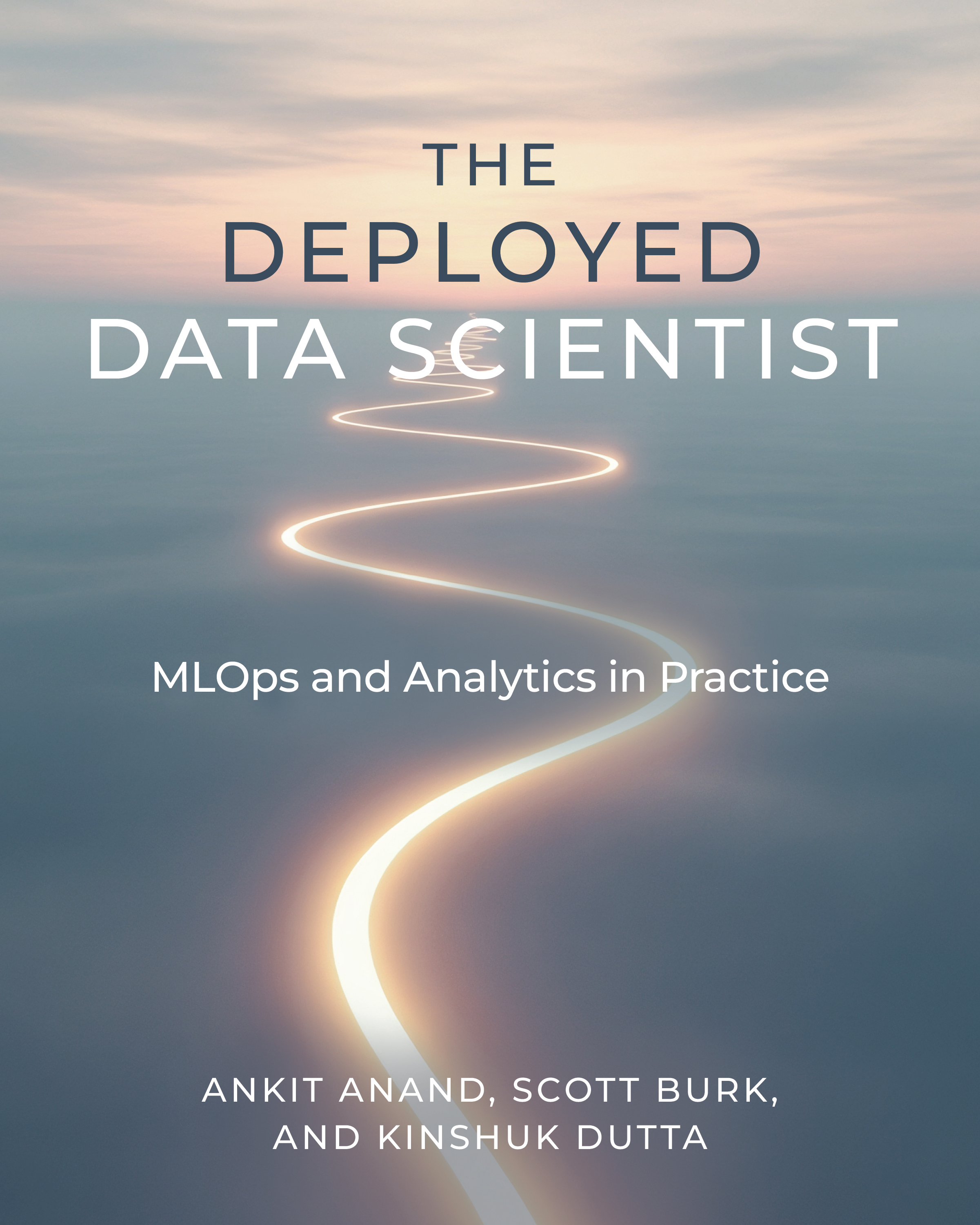
The Deployed Data Scientist is a practical guide to deploying, operating, monitoring, and scaling machine learning and analytics systems in production. It connects data strategy, model engineering, CI/CD, cloud infrastructure, observability, LLMOps, and business ownership into one operating model for dependable AI.
Bibliographic record
Author relationship
Read the roadmap
Each chapter page offers original context, practical questions, and a direct path back to the canonical book record.
Reader questions
It is a practical guide to turning machine learning experiments into dependable production systems, covering data, models, deployment, monitoring, governance, and business ownership.
It is written for data scientists, ML engineers, data leaders, analytics professionals, architects, and anyone responsible for the outcomes of an AI system.
Yes. Data scientists will find a path beyond the notebook, while ML engineers will find a systems view spanning pipelines, registries, CI/CD, cloud infrastructure, and operations.
It covers data strategy, data contracts, model selection, evaluation, registries, containerization, testing, continuous integration, continuous delivery, cloud architecture, observability, retraining, and governance.
Yes. Chapter 8 covers the LLM lifecycle, prompt engineering, Retrieval-Augmented Generation, hallucination monitoring, cost, latency, and production LLM operations.
Yes. Model monitoring and observability are central to Chapter 6, CI/CD is developed in Chapter 4, and data contracts are introduced as a foundation in Chapters 1 and 2.
It focuses on what happens after the model works: reliable data, deployment, feedback loops, monitoring, accountability, and the operating choices that make AI useful to a business.
No advanced specialization is required. Familiarity with data science, software delivery, or analytics helps, but the book is designed to give readers the shared language needed across those disciplines.
Available now
Use the ISBN-13 979-8898160982 when comparing catalogs and editions.